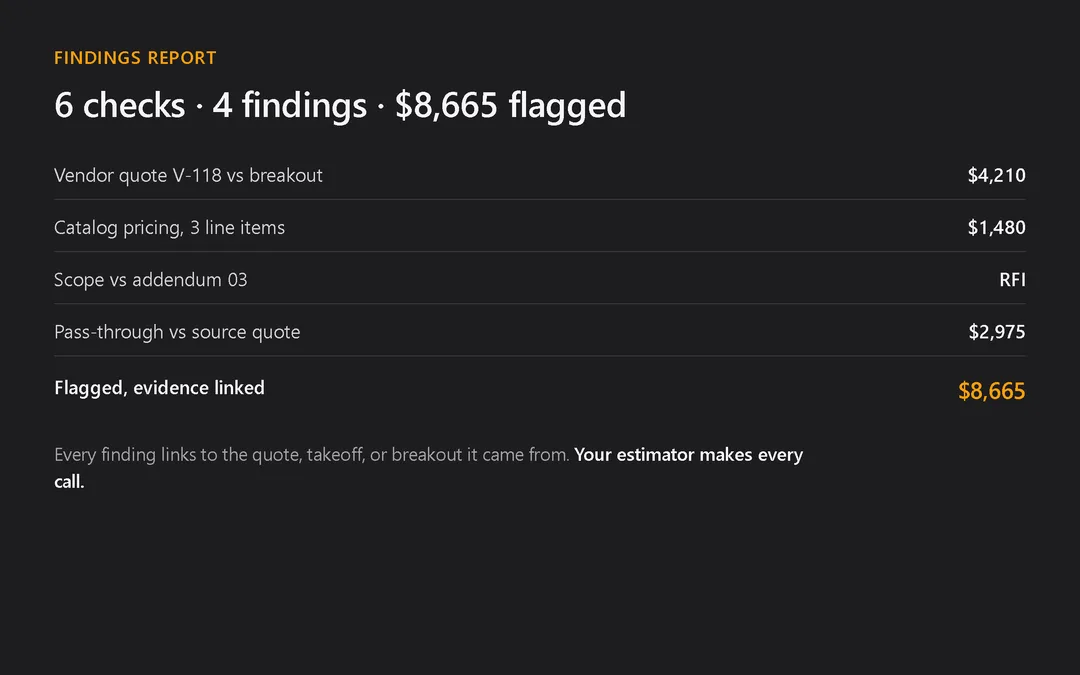
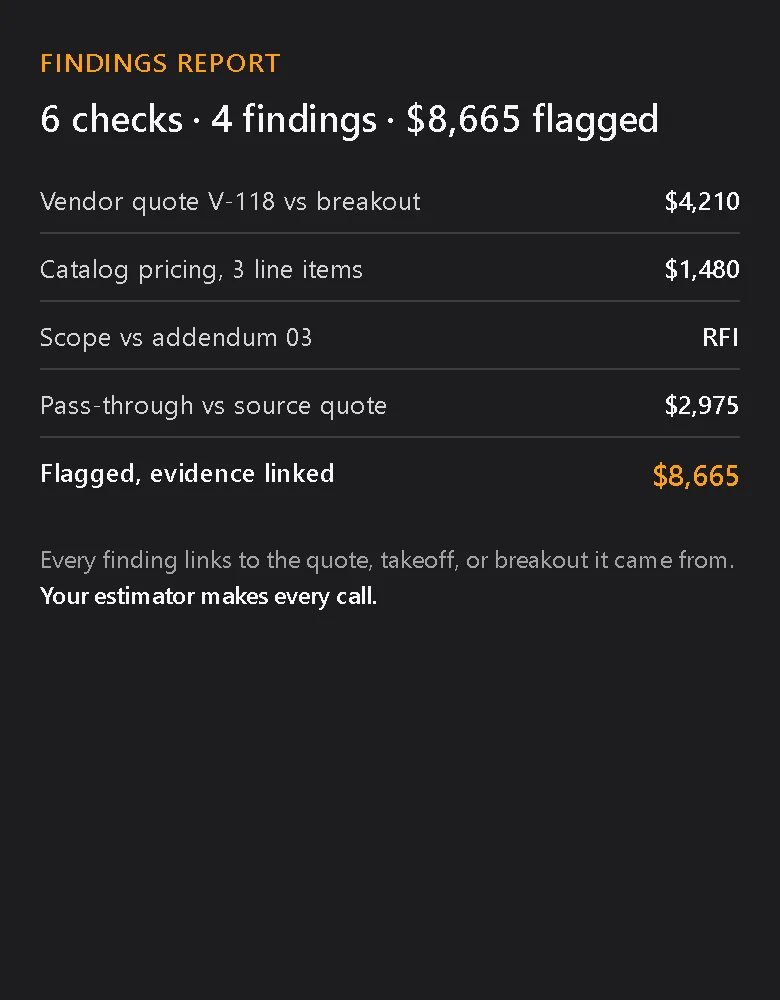
Staged demo on synthetic data: the review steps through six checks one at a time, each check zooms in with its result, three findings come back with dollar amounts, and a findings report holds on 6 checks, 4 findings, $8,665 flagged with evidence linked.Staged demo on synthetic data: the review steps through six checks one at a time, each check zooms in with its result, three findings come back with dollar amounts, and a findings report holds on 6 checks, 4 findings, $8,665 flagged with evidence linked.
For electrical and lighting-controls contractors

Your estimators are checking the same numbers twice, on a Saturday.

I remove hundreds of hours of repetitive estimating work a year without lowering the quality of the bid. On $2.7M of bids I reviewed, the checks caught $131,573 the company had already earned and was about to give away.

Where margin leaks

The bid gets done. The checking doesn't.

The strain shows up the same way in most contracting businesses:

An estimator doing takeoffs on Saturday because the bid is due Tuesday.

An owner still reviewing drawings at ten at night.

A project manager helping bid work instead of running it.

A vendor quote that lands thirty minutes before the deadline.

Nobody re-checks a finished bid on a night like that. On the bids I reviewed, the errors nobody had time to catch came to 4.9% of bid value. On $10M of bids a year, that rate is roughly $490,000. Run it against your own volume.

The receipts

One review found $131,573.

These are finished, checked bids from real estimating work. The review ran after the team was done, and this is what was still sitting in them.

Flagship case study / Bid review

An automated review of finished bids surfaced $131,573.

The review reconciles internal quotes, manufacturer quotes, bid breakouts, takeoffs, catalog prices, and service rules. It surfaces disagreements with the evidence attached, then leaves correction and approval to the estimator.

Approximately $2.7M reviewedVerified catch rate of 4.9%Estimator approval retained
Read the case study
Bid QA reviewAnonymized
Breakout conflicts with reconciled takeoffReview
Pass-through amount differs from sourceReview
Service rule not carried consistentlyReview
Evidence attached for estimator decisionHuman
Cumulative value surfaced$131,573
Validation / Pricing automation QA

The automation failed its test. So it was not allowed to ship.

An adversarial QA harness showed that an ambiguous fuzzy matching path was wrong in 63 of 66 cases. The path was removed from automatic pricing, while the validated exact match workflow remained in production.

63 / 66 fuzzy guesses wrong · 20 / 20 exact references correct
Read the case study
Workflow automation / Quote assembly

A raw vendor export became an import-ready quote in one pass.

It turned a 24-line source into an 88-line structured quote, preserving ERP-critical fields, applying catalog pricing from one shared source, and removing the manual steps where prior transcription errors occurred.

20 / 20 pilot prices correct · 91 / 98 on an unrelated job
Read the case study
100Approximately 100 hours of manual work saved each week, the combined total across all connected workflows.
Data preparationAutomated
Quote assemblyAutomated
ReconciliationAssisted
Exceptions and approvalHuman
Operating principle

Automation earns authority only after it survives contact with real outcomes.

every case above shipped under that rule. or did not ship.
$131,573Missed revenue and estimating errors surfaced
$2.7MApproximate bid value reviewed so far
~100 hrsManual work saved weekly, total across all connected workflows
10+ yearsCommercial construction management and estimating
The offer

Review your bid.

Nothing to install, nobody to train, no workflow to change. Pick a bid package your team already finished and I run the same checks that caught the $131,573. Fixed fee, quoted flat before you send a single file.

Step 01

What you send

One finished bid package. Quotes, takeoff, breakouts, the documents your team already produced. A job you shipped last month works best, because the review gets judged against work you already trusted.

Step 02

What you get back

An itemized findings report: missing scope, contradictions, pricing conflicts, pass-through errors, RFI candidates, and an executive summary with the dollar impact. Every finding links to the document it came from, and every call stays with your estimator.

Step 03

What happens after

If the review comes back clean, your team did good work and now you have proof. If it finds money, we talk about running the same checks every week: bid review, document QA, quote comparison, wherever your workflow bleeds. The review earns that conversation or it doesn't.

The uncommon combination

I did the work before I built the systems.

Ten years of estimating and project management taught me where bids lose money. Four years of building production AI taught me how to catch it without handing your team another system to manage.

10+

Years in commercial construction

I have run project management and estimating across Division 26 electrical systems, lighting controls, vendor coordination, scope, and pricing, under the bid-day deadlines that make small inconsistencies expensive.

4

Years building production AI systems

I build and operate the systems myself: agents, retrieval, orchestration, evaluation, local and cloud inference, and the privacy controls required when outputs affect real work.

The advantage is not knowing both worlds. It is knowing what deserves to cross between them.
Working method

Observe the work before automating it.

A practical sequence for separating true leverage from impressive technology that creates another system to manage.

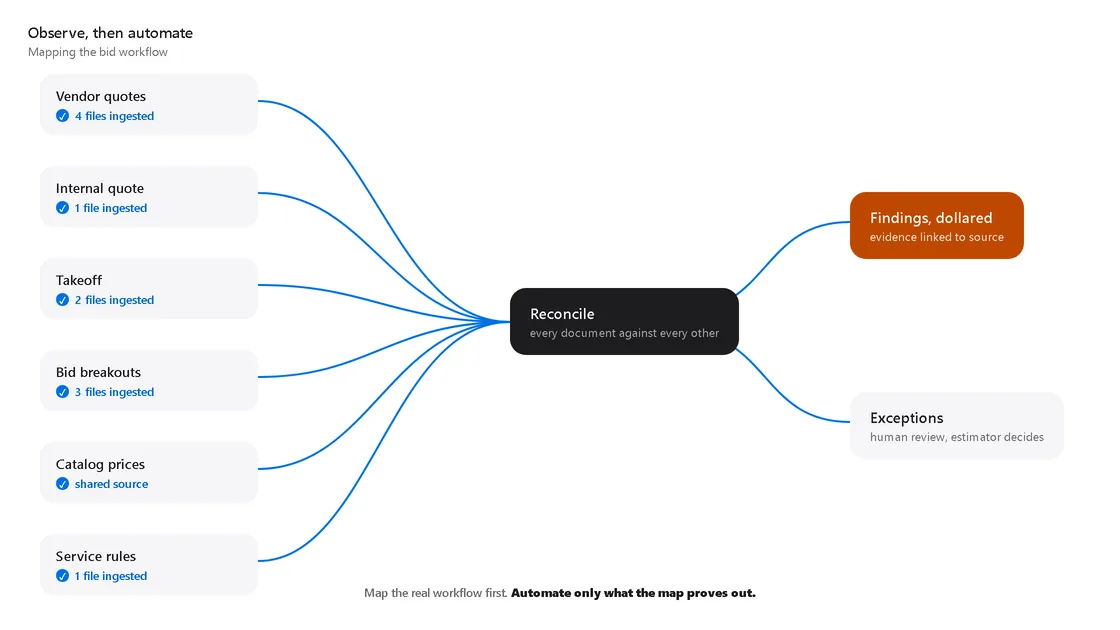
Staged demo on synthetic data: the bid workflow is mapped as vendor quotes, internal quote, takeoff, breakouts, catalog prices, and service rules feed a reconcile step, which routes dollared findings and exceptions to the estimator.
Step 01

Observe

Map the real workflow, documents, decisions, exceptions, handoffs, and failure points.

Step 02

Find leverage

Estimate where errors, rework, delay, or administrative load create the greatest commercial cost.

Step 03

Build the smallest useful system

Prototype around one consequential workflow instead of attempting a company-wide transformation.

Step 04

Prove it

Measure outcomes, preserve human review, document the process, and expand only when the evidence supports it.

Trust model

Built for confidential and consequential work.

Construction data is not portfolio material. Responsible implementation begins with protecting the business, the people, and the source documents.

01
Anonymized public workNo job names, clients, part numbers, manufacturers, or real project pricing in published examples.
02
Minimum necessary accessUse only the information required to solve the defined problem.
03
Traceable evidenceImportant outputs point back to their source inputs, assumptions, and failure conditions.
04
Explicit human approvalAutomation assists accountable decisions. The person responsible sees and approves every consequential output.
05
Honest tool boundariesTechnology choices follow the workflow. Expertise is never invented to fit a sales call.
Start with one bid

See what last month's bids are hiding.

Send a note with the kind of work you bid. I reply with a flat fee and a short list of what to send. You keep the findings report either way, and if the honest answer is that your process doesn't need me, that is the answer you get.

Direct contacthello@josiahbujanda.com

For initial conversations, describe the workflow without attaching confidential project documents.